
Quick answer
Menu engineering analytics classifies each dish by popularity and margin into stars, plowhorses, puzzles, and dogs so operators know what to price, promote, or delist. It uses POS mix and food cost to show which items improve profit, not just order volume, before menu redesigns and campaigns.
Menu engineering analytics is the practice of measuring how each item on a restaurant menu performs for both customer demand and profitability, then using that view to change prices, portioning, placement, and promotions with intent. In India, it matters for full-service dining, QSRs, and cloud kitchens alike, where food cost, packaging, and aggregator commissions can flip an apparently popular item into a margin drain.
The approach is often shown as a 2x2 (BCG-style) matrix. Sales mix or order counts show popularity; food cost, recipe cost, and net margin after discounts show profitability. The intersection tells you which dishes to feature, re-cost, retrain staff to sell, or remove. For the broader analytics layer behind recipe cost and usage control, see food cost analytics.
This page explains the four menu categories, how to read popularity versus profit, and how FireAI supports menu and product analytics for food and beverage teams by classifying line items from POS and recipe data, not from gut feel.
The Four Menu Engineering Categories (Stars, Plowhorses, Puzzles, Dogs)
| Category | Popularity | Profitability | Typical action |
|---|---|---|---|
| Star | High | High | Keep visible; protect recipes; use in hero imagery and combos that preserve margin. |
| Plowhorse | High | Low | Re-price, re-portion, swap ingredients, or trim discounts and aggregator-funded offers that cap margin. |
| Puzzle | Low | High | Increase visibility (menu real estate, server suggestions, in-app placement), or bundle with high-traffic items. |
| Dog | Low | Low | De-list, limit hours, or replace with a better-fit SKU so kitchen complexity drops without losing cover-driving dishes. |
These labels come from a simple fact: volume alone is the wrong way to pick winners. A best-selling biryani with thin margin after Zomato or Swiggy fees may be a plowhorse; a high-margin regional specialty with modest orders may be a puzzle worth promoting.
Popularity vs Profitability: What to Measure
Popularity is usually share of total covers, item count, or revenue over a period (weekly or monthly) by outlet or across a chain. Normalise for seasonality, festivals, and new launches so a short promotion does not permanently skew classification.
Profitability should reflect what the kitchen and finance team actually see after:
- Recipe and ingredient cost (including yield and waste)
- Packaging and consumables for delivery
- Platform commission and payment fees for aggregator-heavy brands
- Promotions and discounts tied to the SKU or category
In Indian operations, the same item often behaves differently by city or channel: dine-in may show healthy margin while delivery, after fees, lands in the plowhorse quadrant. Good menu engineering analytics splits the matrix by channel and outlet when data allows.
How FireAI Auto-Classifies Menu Items From POS Data
Manually classifying a 40-item menu in spreadsheets every month does not scale. FireAI is built to:
- Ingest POS or order-management exports (and connected sources your team already uses) so item-level sales and mix update continuously.
- Layer recipe or category-level cost assumptions (from finance or your recipe master) to approximate contribution per item, then refine with actual COGS when available.
- Apply the star / plowhorse / puzzle / dog logic automatically and refresh classifications as mix and costs change, so marketing and operations react to a live view instead of a quarterly deck.
You can still ask ad hoc questions in natural language (for example, which new launches moved from puzzle to star last quarter) alongside the default menu-engineering view.
Practical Uses for F&B in India
- Pricelist and reprint decisions: Feature stars and high-potential puzzles; demote dogs from printed menus in dine-in, or from top folds on QR menus and apps.
- Combo and meal strategy: Pair plowhorses with puzzles or add-ons that lift check without eroding the core dish margin.
- Aggregators: Compare net margin by item and channel; plowhorses on platforms may need a different price or a delivery-only LTO replacement with better unit economics.
- Ops and training: Puzzles with strong margin but low sell-through often need staff storytelling or a photograph and description refresh, not an immediate delist.
For a deeper look at how product and menu data ties into a broader F&B stack, start from Menu & product use cases for food and beverage.
Common Pitfalls in Menu Engineering
1. Using list price, not net margin, after offers and fees. Your POS line may look healthy until delivery adjustments land.
2. One global matrix for all outlets. A puzzle in Mumbai may be a star in a smaller market; item-level and outlet-level cuts prevent bad chain-wide policy.
3. Ignoring cross-sell. A "dog" starter might help sell a star main; analytics should sometimes treat courses as a bundle, not only isolated line items.
4. Static categories. With seasonal menus and LTOs, recalculate labels monthly or when a campaign materially shifts mix.
Ready to act on your data?
See how teams use FireAI to ask in plain language and get analytics they can trust.
Explore FireAI workflows
Go from this topic into product features and solution paths that match what you read here.
Topic hub
Industry Analytics In India
Comparison pages and implementation guidance for industry-specific BI, dashboards, and analytics use cases in India.
Explore hubFrequently asked questions
Related in this topic
What Is Food Cost Analytics for Restaurants?
Food cost analytics turns recipes, purchases, and POS sales into food cost percentage, actual vs theoretical usage, and waste signals. Learn how Indian restaurants and QSRs use it to protect margin, and how FireAI connects POS and inventory for live F&B dashboards.
How to Track Food Cost Percentage for Restaurants (Step-by-Step)
Practical steps to track restaurant food cost percentage: ingredient master data, recipe costing, actual versus theoretical usage, variance analysis, and automation from POS and inventory. How FireAI helps F&B teams in India monitor margin without spreadsheet churn.
Best BI Tools for Hospitality in India (2026)
Compare the best business intelligence tools for Indian hospitality — hotels, restaurant chains, resorts, and food service companies. Find BI platforms built for RevPAR, occupancy tracking, and F&B analytics.
Best BI Tools for Food & Beverage in India (2026)
Compare the best BI and analytics platforms for Indian restaurants, QSRs, and F&B chains. See how tools stack up on menu engineering, food cost tracking, outlet benchmarking, and finance dashboards tied to POS and Tally.
From the blog
What Is a Data Silo and Why Is It Slowing Down Your Business?
Data silos are silently costing Indian businesses time, money and decisions. Here is what they are, why they form and how to break them for good with FireAI.

Democratizing Data: How AI Analytics Levels the Playing Field for Small Businesses and Freelancers
For decades, data-driven decision making was a luxury that only enterprises could afford. Big companies hired data scientists, purchased expensive BI tools, and built complex data warehouses. In exchange, they received precise insights that guided budgets, strategy, and growth.
Measuring Promotion Effectiveness: A Data-Driven Guide for FMCG Marketers
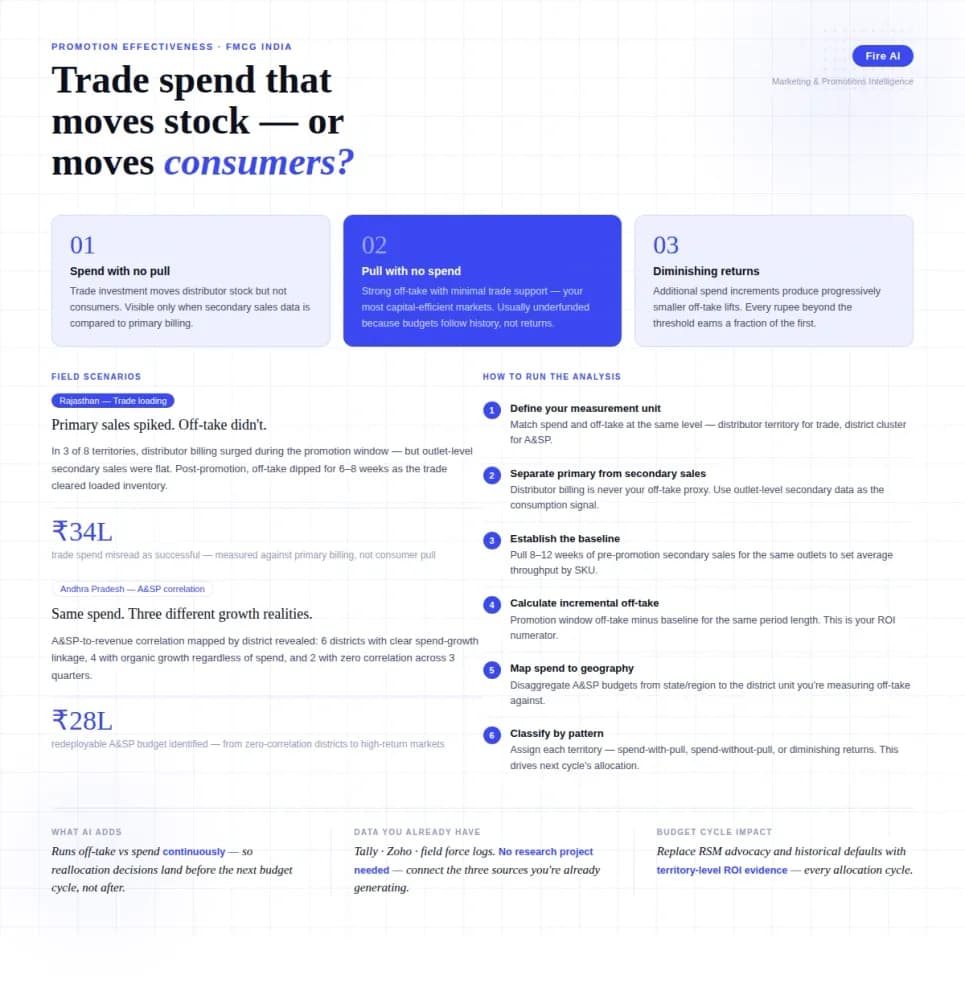
FMCG brands in India spend 15–25% of gross revenue on trade promotions and A&SP (advertising and sales promotion) every year. Most can tell you how much they spent. Very few can tell you what it returned. The problem isn't a lack of data — it's that the data lives in disconnected places. Trade spend sits in finance. Off-take data lives with the distributor or field team. A&SP budgets are tracked in a marketing spreadsheet. No single view ties promotional investment to consumer pull at the outlet level. The result is a budget cycle where last year's spend allocation becomes next year's default, because no one has the numbers to argue for something different. This guide walks through how FMCG marketing and trade teams can build a promotion effectiveness framework that actually connects spend to outcome — not just channel-level assumptions.