Outlet-Wise P&L for Restaurants: Finally Know Which Location Makes Money

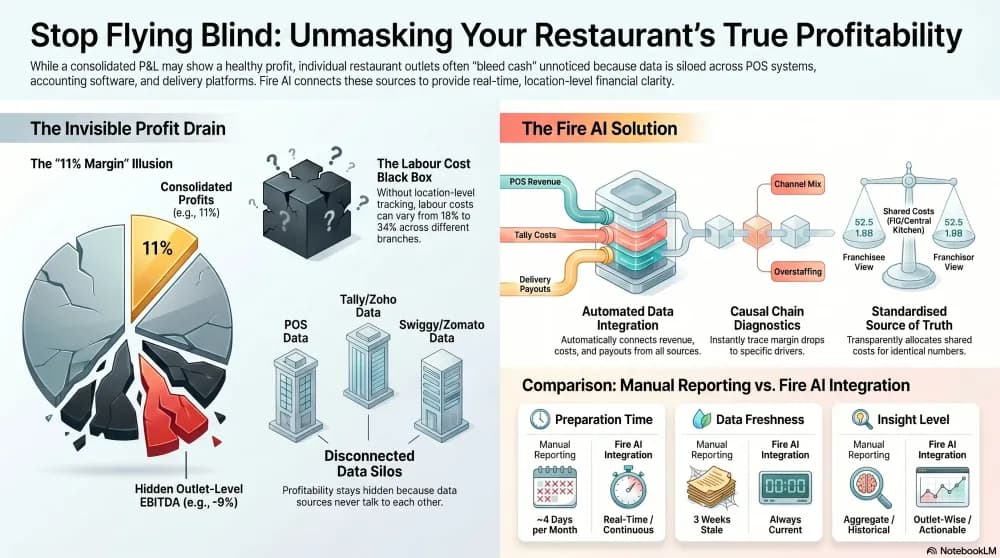
Here's a pattern that plays out across restaurant chains in India more often than anyone admits. Total revenue is growing. New outlets are opening. The consolidated P&L shows a healthy margin. But when someone finally sits down to build an outlet-level P&L — usually during a funding round, a franchise dispute, or a cost crisis — the picture is very different. Two or three locations are generating almost all the profit. Several are breakeven. And a few are bleeding cash that the strong performers are quietly covering.
The reason this stays hidden isn't negligence. It's infrastructure. Most multi-outlet restaurant businesses in India run their accounting on Tally or Zoho Books, their POS on a separate system (Petpooja, POSist, Rista, or similar), and their delivery data through Swiggy and Zomato dashboards. Labour schedules live in spreadsheets. Rent and CAM charges sit in lease agreements that nobody maps back to location-level profitability in real time.
The data to build an outlet-wise P&L exists. It just doesn't live in one place — and nobody has the bandwidth to stitch it together manually every month for every location.
That's the problem Fire AI solves. Not by replacing your accounting software or your POS, but by connecting them into a unified analytical layer where outlet-level profitability is always visible, always current, and queryable by anyone who needs the answer.
Why Don't Most Restaurant Chains Have Outlet-Level P&Ls?
It's not that finance teams don't want them. It's that building them manually is painful enough to do once a quarter at best — and by then, the numbers are historical rather than actionable.
Revenue looks simple but isn't. A single outlet's revenue comes from dine-in, takeaway, Swiggy, Zomato, direct delivery, catering, and sometimes corporate orders. Each channel has different commission structures, discount policies, and payout timelines. Reconciling actual net revenue per outlet — after platform commissions, discounts, and GST — requires pulling data from three or four systems.
Cost allocation is where it falls apart. Some costs are clearly outlet-specific: rent, local staff salaries, utilities. Others are shared or allocated: central kitchen costs, marketing spend, HQ overheads, commissary supplies. Without a consistent allocation methodology applied automatically, outlet-level cost data is either missing or unreliable.
Labour cost is the black box. Labour is typically the second-largest cost line after food. But most chains track it in aggregate or by payroll cycle, not by outlet-by-month in a format that's connected to revenue. When labour cost as a percentage of revenue varies from 18% at one outlet to 32% at another, that gap is invisible until someone manually computes it.
Nobody reconciles delivery platform payouts at the outlet level. Swiggy and Zomato payout reports are notoriously difficult to reconcile — commissions, surge charges, marketing deductions, and payout cycles don't align neatly with your invoice data. Most chains reconcile at the aggregate level, if at all. Outlet-wise net revenue from delivery channels is essentially unknown.
The core problem: Outlet-wise P&L requires connecting POS revenue, delivery platform payouts, Tally or Zoho cost data, labour records, and shared cost allocations into a single location-level view. Most restaurant chains have all five data sources. None of them talk to each other.
What This Looks Like in Practice
Scenario 1: The 9-Outlet QSR Chain Where 3 Outlets Were Funding the Other 6
Rohan co-founded a QSR brand in Bengaluru — nine outlets across the city, a central kitchen, and a mix of dine-in and delivery revenue. The consolidated P&L showed an 11% EBITDA margin. Investors were happy. Rohan was not — because he had a gut feeling that not all outlets were pulling their weight, but couldn't prove it.
His finance team ran on Tally for accounting, Petpooja for POS, and manually tracked delivery payouts from Swiggy and Zomato in a shared spreadsheet. Building a single outlet-level P&L took the finance manager roughly four days per month — and by the time it was ready, it was three weeks stale.
When Rohan connected all three data sources to Fire AI, the platform's data pipelines pulled revenue data from Petpooja at the outlet and channel level, mapped Tally cost entries to locations using pre-configured allocation rules, and ingested delivery platform payout reports to compute net delivery revenue after commissions.
The first outlet-wise P&L dashboard told the story Rohan suspected but couldn't see. Three outlets — Indiranagar, Koramangala, and Whitefield — were running EBITDA margins between 18–22%. Two outlets were roughly breakeven. And four outlets were loss-making, with EBITDA margins between negative 3% and negative 9%.
The consolidated 11% margin had been masking ₹14 lakh in monthly losses across four locations.
Fire AI's causal chain helped Rohan diagnose why. For two of the four loss-making outlets, the primary driver was labour cost — running at 31% and 34% of revenue respectively, versus a chain average of 22%. These outlets were overstaffed relative to their footfall, but nobody had connected headcount to outlet-level revenue before. The other two had a revenue problem: delivery commissions were eating 28–30% of gross revenue (heavy Swiggy/Zomato mix, minimal dine-in), and once commissions were deducted, the net revenue couldn't cover even the fixed cost base.
Rohan's decisions were different for each. The overstaffed outlets got shift restructuring — reducing overlap hours and rebalancing staff from low-traffic to high-traffic shifts — which brought labour cost down to 24% within two months. For the delivery-heavy outlets, he ran a dine-in promotion to shift channel mix and renegotiated commission tiers with both platforms using the outlet-level data as leverage.
None of these decisions were possible without outlet-wise P&L. And none would have been timely without it updating continuously.
Scenario 2: The Franchise Chain That Settled a Dispute With Data
Meghna operates a 14-outlet franchise brand across Mumbai and Pune — five company-owned, nine franchised. A recurring friction point: franchisees claimed their outlets weren't profitable despite healthy topline numbers, and blamed high commissary costs (raw material supplied by the central kitchen). The franchisor team believed franchisees were overspending on local labour and marketing.
Neither side had outlet-level data to prove their case.
When Meghna deployed Fire AI across the chain — connecting Zoho Books (accounting), the brand's POS system, and delivery platform reports — every outlet got a standardised P&L for the first time. Revenue by channel, COGS from commissary invoices, local labour cost, rent, utilities, delivery commissions, and a transparent allocation of shared costs like brand marketing.
The data settled the argument — and both sides were partially right. Commissary food cost at franchised outlets was indeed 2–3 percentage points higher than company-owned outlets, because franchisees were ordering in smaller batches and incurring higher per-unit logistics costs from the central kitchen. But labour cost at franchised outlets varied wildly — from 19% to 36% of revenue — while company-owned outlets clustered tightly at 21–23%.
Fire AI's scheduled reports now deliver a monthly outlet P&L to every franchisee and to the franchisor team simultaneously — same numbers, same methodology, same source of truth. Disputes have dropped because both sides see the same data. Franchisees with high labour costs have specific, quantified targets to work toward. And commissary pricing was restructured to offer volume tiers, which reduced food cost for the smaller franchisees by 1.5 percentage points.
Meghna used Ask FireAI to set up the query she gets asked most often by the board: "same-store growth by outlet, this quarter vs. last quarter, excluding new openings." The answer is now one question away instead of a half-day finance exercise.
How Does Fire AI Make Outlet-Wise P&L Work?
Data pipelines that connect POS, accounting, and delivery platforms. Fire AI's 250+ connectors pull revenue data from your POS (Petpooja, POSist, Rista, or custom), cost data from Tally or Zoho Books, and delivery payouts from platform reports — unified at the outlet level automatically. The ETL layer handles the messy reality: different revenue recognition timings, commission structures that change monthly, GST adjustments, and multi-entity consolidation for franchise chains.
Configurable cost allocation rules. Shared costs — central kitchen, HQ overhead, brand marketing — can be allocated by revenue share, outlet square footage, headcount, or custom logic. The rules are set once and applied continuously, so every outlet P&L uses a consistent methodology.
Causal chain for diagnosing profitability drivers. When an outlet's margin drops, Fire AI's causal chain traces whether it's a revenue problem (footfall decline, channel mix shift, higher discounting), a cost problem (labour creep, rent escalation, commissary pricing), or a combination. The diagnosis is specific and quantified, not a general alert.
Same-store growth analysis, always current. Fire AI's dashboards track same-store revenue and margin trends by outlet, excluding new openings, with configurable comparison periods — week-on-week, month-on-month, or same-month-last-year. No manual filtering.
Labour cost as % of revenue, by outlet, by period. When payroll data flows into Fire AI alongside POS revenue, the platform computes and tracks this ratio continuously. Smart alerts fire when any outlet's labour percentage breaches a configurable threshold — before the month-end P&L makes it official.
Role-based access through Data Guard. The CFO sees all outlets. A franchise partner sees only their locations. A city operations head sees their cluster. Outlet-level financial data is sensitive — Data Guard ensures the right people see the right numbers, down to column-level permissions.
What Fire AI does differently: It doesn't ask you to move your accounting off Tally or replace your POS. It connects to where your financial and operational data already lives and delivers outlet-level P&L as a continuously updated, queryable layer — not a quarterly spreadsheet project.
What Decisions Does Outlet-Wise P&L Unlock?
Close, fix, or double down — with data. When you know which outlets are profitable and which aren't, and why, the decision to invest, restructure, or exit a location stops being political and starts being analytical.
Negotiate leases and commissions with specifics. Outlet-level net margin data is leverage — whether you're renegotiating rent at renewal, pushing back on delivery platform commission hikes, or presenting a franchise profitability case to investors.
Catch margin erosion in weeks, not quarters. Fire AI's anomaly detection surfaces outlet-level margin shifts as they happen. A labour cost spike, a channel mix shift toward higher-commission delivery, or a commissary price increase — these show up in real time, not in a retrospective P&L review.
Benchmark outlets against each other. When all outlets run on the same P&L methodology, you can identify what top-performing locations do differently — and replicate it.
How Do I Get Started?
If your restaurant chain runs on Tally or Zoho for accounting and has a POS system capturing outlet-level sales, Fire AI can connect both, layer in delivery platform data, and deliver your first outlet-wise P&L within days.
Start with your five most important outlets. See the real margin — after delivery commissions, after labour, after shared cost allocation. Compare it to what you thought the margin was.
That gap is your answer.
Ready to see which outlets are actually making money? See your outlet P&L on Fire AI → FIREAI
The scenarios described above are based on real restaurant P&L patterns observed across multi-outlet F&B chains. Names, locations, and specific figures have been changed to protect confidentiality.
Posted By:

Ishita Shah
Content Editor, FireAI
10+ years of leading Product Management, New Ventures and Project roles at Delhivery, Zomato, and eInfo Solutions. Notion Affiliate and Member of Insurjo Cohort.
10+ years of leading Product Management, New Ventures and Project roles at Delhivery, Zomato, and eInfo Solutions. Notion Affiliate and Member of Insurjo Cohort.
Loading...