
Quick answer
Prescriptive analytics uses AI and optimisation algorithms to recommend specific actions that maximise business outcomes. It goes beyond predicting what will happen—it tells you what to do next. For example, it can recommend which products to restock, where to allocate ad spend, or how to adjust pricing. FireAI delivers prescriptive insights through natural language queries.
Prescriptive analytics uses advanced algorithms and artificial intelligence to recommend specific actions that optimize business outcomes. Going beyond predictive analytics that forecasts what will happen, prescriptive analytics determines what should be done and provides actionable recommendations to achieve desired results.
Prescriptive analytics represents the highest level of analytical maturity, building on descriptive analytics (what happened), diagnostic analytics (why it happened), and predictive analytics (what will happen). This transformative approach shifts organizations from reactive and predictive decision-making to proactive optimization, enabling automated, data-driven recommendations that maximize business performance.
What is Prescriptive Analytics?
Prescriptive analytics applies advanced algorithms, artificial intelligence, and optimization techniques to recommend specific actions that will achieve the best possible outcomes. Unlike descriptive analytics that explains what happened, diagnostic analytics that identifies why it happened, and predictive analytics that forecasts what might happen, prescriptive analytics determines what should be done to optimize results.
The technology combines predictive modeling with optimization algorithms and business rules to generate actionable recommendations. By simulating different scenarios and evaluating potential outcomes, prescriptive analytics helps organizations make optimal decisions in complex, dynamic environments.
Core Characteristics
Actionable Recommendations: Provides specific, implementable suggestions rather than general insights or predictions.
Optimization Focus: Uses mathematical optimization techniques to find the best possible course of action within constraints.
Scenario Simulation: Tests multiple decision scenarios to identify optimal outcomes before implementation.
Automated Decision-Making: Can trigger automated actions when predefined conditions are met.
Contextual Intelligence: Considers business rules, constraints, and objectives when making recommendations.
How Prescriptive Analytics Works
Problem Formulation
Prescriptive analytics begins by clearly defining the decision problem:
- Identifying objectives and desired outcomes
- Defining constraints and limitations
- Specifying decision variables and their ranges
- Establishing evaluation criteria and success metrics
Data Integration
Systems gather comprehensive data for decision-making:
- Historical performance data for predictive modeling
- Real-time operational data for current conditions
- External data sources for market and environmental factors
- Business rules and constraints for compliance
- Cost and resource data for optimization
Predictive Modeling
Advanced algorithms forecast potential outcomes:
- Machine learning models predict results of different actions
- Statistical models estimate probabilities and uncertainties
- Simulation models test various scenarios
- Time series analysis forecasts future conditions
Optimization Algorithms
Mathematical optimization finds optimal solutions:
- Linear programming for resource allocation problems
- Integer programming for discrete decision variables
- Nonlinear optimization for complex relationships
- Multi-objective optimization for competing goals
- Constraint optimization for real-world limitations
Recommendation Generation
AI systems provide actionable guidance:
- Ranked recommendations with confidence scores
- Implementation steps and timelines
- Risk assessments and mitigation strategies
- Alternative options with trade-off analysis
- Automated execution triggers when appropriate
Prescriptive Analytics vs Other Analytics Types
Descriptive Analytics
Descriptive analytics answers "What happened?":
- Summarizes historical data and current state
- Provides dashboards and basic reporting
- Focuses on understanding past performance
- Enables basic monitoring and awareness
- Foundation for all other analytics types
Diagnostic Analytics
Diagnostic analytics answers "Why did it happen?":
- Identifies root causes and relationships
- Performs drill-down and correlation analysis
- Explains factors contributing to outcomes
- Enables problem-solving and improvement
- Supports understanding of causal relationships
Predictive Analytics
Predictive analytics answers "What is likely to happen?":
- Forecasts future outcomes based on historical patterns
- Uses statistical modeling and machine learning
- Provides probability estimates and confidence intervals
- Enables risk assessment and planning
- Supports proactive decision-making
Prescriptive Analytics
Prescriptive analytics answers "What should we do?":
- Recommends optimal actions and decisions
- Uses optimization and simulation techniques
- Provides specific, actionable recommendations
- Enables automated decision execution
- Supports strategic optimization and automation
| Analytics Type | Focus | Key Question | Methodology | Business Impact |
|---|---|---|---|---|
| Descriptive | What happened | What are our sales? | Reporting, dashboards | Awareness |
| Diagnostic | Why it happened | Why did sales drop? | Root cause analysis | Problem-solving |
| Predictive | What will happen | What will sales be? | Forecasting, ML | Risk management |
| Prescriptive | What should we do | How to increase sales? | Optimization, AI | Decision automation |
Key Capabilities
Scenario Optimization
Prescriptive systems evaluate multiple decision options:
- What-if analysis for different strategies
- Trade-off evaluation between competing objectives
- Risk-adjusted optimization considering uncertainties
- Sensitivity analysis for critical variables
- Monte Carlo simulation for probabilistic outcomes
Resource Allocation
Optimization algorithms determine optimal resource distribution:
- Budget allocation across marketing channels
- Workforce scheduling and staffing decisions
- Inventory optimization and supply chain decisions
- Capital investment prioritization
- Production planning and capacity utilization
Dynamic Pricing
Real-time pricing optimization for maximum revenue:
- Demand-based pricing adjustments
- Competitive pricing responses
- Promotional pricing optimization
- Customer segmentation pricing
- Seasonal and event-based pricing
Process Automation
Automated decision execution based on analytics:
- Automated reordering when inventory reaches thresholds
- Dynamic pricing adjustments based on market conditions
- Automated customer communication triggers
- Workflow automation based on predictive insights
- Alert systems with recommended response actions
Strategic Planning
Long-term optimization for business strategy:
- Portfolio optimization for investment decisions
- Market expansion and entry strategy recommendations
- Product development prioritization
- Merger and acquisition target evaluation
- Competitive strategy formulation
Applications Across Industries
Retail and E-commerce
Prescriptive analytics optimizes retail operations:
- Dynamic pricing recommendations for products
- Inventory optimization across supply chain
- Personalized product recommendations
- Promotional campaign optimization
- Store layout and merchandising decisions
Financial Services
Financial institutions leverage prescriptive capabilities:
- Portfolio rebalancing recommendations
- Credit limit optimization for customers
- Fraud prevention action recommendations
- Investment strategy optimization
- Risk management and capital allocation
Manufacturing
Manufacturing benefits from operational optimization:
- Production scheduling and line balancing
- Supply chain optimization and vendor selection
- Quality control and defect prevention
- Maintenance scheduling and resource allocation
- Energy consumption and cost optimization
Healthcare
Healthcare organizations improve patient outcomes:
- Treatment plan optimization for individual patients
- Resource allocation for hospital capacity
- Drug dosage and medication optimization
- Appointment scheduling and patient flow
- Preventive care and intervention recommendations
Marketing and Sales
Marketing teams optimize customer acquisition and retention:
- Campaign budget allocation across channels
- Customer acquisition strategy optimization
- Churn prevention action recommendations
- Cross-sell and upsell opportunity identification
- Marketing message and timing optimization
Technical Implementation
Optimization Engines
Prescriptive analytics relies on advanced optimization technology:
- Mathematical programming solvers for complex optimization
- Heuristic algorithms for large-scale problems
- Machine learning integration for predictive optimization
- Real-time optimization for dynamic environments
- Distributed computing for scalability
Decision Frameworks
Structured approaches to prescriptive recommendations:
- Decision trees and rule-based systems
- Expert systems with business logic
- Machine learning models for pattern-based decisions
- Simulation models for scenario testing
- Multi-criteria decision analysis
Integration Patterns
Prescriptive systems integrate with business applications:
- APIs for real-time decision support
- Workflow automation triggers
- Dashboard integration for user consumption
- Mobile applications for field decisions
- IoT integration for operational decisions
Governance and Control
Enterprise implementation requires governance:
- Decision audit trails and accountability
- Risk controls and approval workflows
- Compliance with regulatory requirements
- Performance monitoring and adjustment
- Human oversight and intervention capabilities
Benefits and Challenges
Business Benefits
Optimal Decision-Making: Organizations consistently make better decisions by considering all relevant factors and constraints.
Automation of Routine Decisions: Prescriptive systems handle repetitive decisions, freeing human experts for strategic thinking.
Improved Resource Utilization: Optimization ensures resources are allocated to maximum benefit across the organization.
Faster Response Times: Automated recommendations enable rapid response to changing conditions and opportunities.
Competitive Advantage: Organizations that optimize decisions gain significant advantages over competitors using intuition or basic analytics.
Implementation Challenges
Complexity: Prescriptive analytics requires sophisticated mathematical models and computational resources.
Data Requirements: High-quality, comprehensive data is essential for accurate optimization and recommendations.
Business Rule Integration: Complex business constraints and rules must be accurately captured and maintained.
Acceptance and Trust: Organizations must build trust in automated recommendations and establish appropriate oversight.
Change Management: Implementation requires significant organizational change and new decision-making processes.
Best Practices
Start with Clear Objectives
Define specific optimization goals:
- Identify key decisions requiring optimization
- Establish measurable success criteria
- Prioritize high-impact decision areas
- Ensure executive sponsorship and alignment
- Plan for phased implementation and scaling
Ensure Data Quality and Integration
Build strong data foundations:
- Implement comprehensive data quality monitoring
- Integrate data from all relevant sources
- Establish real-time data pipelines
- Maintain data governance and security
- Create data validation and reconciliation processes
Develop Robust Models
Create reliable optimization models:
- Validate model assumptions and constraints
- Test models against historical decisions
- Implement sensitivity analysis for key variables
- Establish confidence levels and risk tolerances
- Plan for model maintenance and updates
Implement Appropriate Controls
Establish governance frameworks:
- Define decision authority and escalation procedures
- Implement audit trails for automated decisions
- Create override capabilities for exceptional cases
- Establish monitoring and performance tracking
- Ensure compliance with regulatory requirements
Focus on User Adoption
Ensure organizational acceptance:
- Provide clear explanations of recommendations
- Train users on interpretation and implementation
- Demonstrate value through pilot programs
- Create feedback mechanisms for improvement
- Build trust through transparency and performance
Monitor and Refine
Continuously improve prescriptive capabilities:
- Track decision outcomes and recommendation accuracy
- Monitor system performance and reliability
- Update models based on new data and outcomes
- Refine business rules and constraints
- Expand to additional decision areas over time
The Future of Prescriptive Analytics
AI-Driven Optimization
Artificial intelligence will enhance prescriptive capabilities:
- Deep learning for complex optimization problems
- Reinforcement learning for dynamic environments
- Natural language processing for unstructured constraints
- Computer vision for visual decision optimization
- Advanced simulation and scenario modeling
Autonomous Decision-Making
Systems will make increasingly autonomous decisions:
- Self-optimizing systems that learn from outcomes
- Real-time adaptation to changing conditions
- Automated execution of routine decisions
- Human-in-the-loop oversight for critical decisions
- Continuous learning and improvement
Integrated Decision Support
Prescriptive analytics will become seamlessly integrated:
- Embedded recommendations in business applications
- Real-time decision support across workflows
- Predictive and prescriptive analytics convergence
- Cross-system optimization and coordination
- End-to-end decision automation
Ethical and Responsible AI
Future systems will emphasize responsible decision-making:
- Fairness and bias mitigation in recommendations
- Transparency in decision-making processes
- Explainability for automated recommendations
- Ethical considerations in optimization objectives
- Human values and constraints in decision frameworks
Prescriptive analytics represents the pinnacle of analytical maturity, where artificial intelligence not only understands what happened and predicts what might happen, but actively recommends optimal courses of action. By combining predictive modeling with optimization algorithms, prescriptive analytics enables organizations to make consistently better decisions that maximize business outcomes and competitive advantage.
How FireAI Uses Prescriptive Analytics
FireAI makes prescriptive analytics practical for Indian businesses—no data science team or optimisation consultants needed:
NLQ-Driven Recommendations: Ask "How should I allocate my ₹10 lakh marketing budget across channels?" and FireAI analyses historical conversion data to recommend the optimal split—no manual modelling required.
Zero-Code Decision Support: Pre-built dashboards surface prescriptive insights automatically. A sales dashboard doesn't just show declining revenue—it highlights which regions, products, and customer segments to focus on for recovery.
Tally-Connected Optimisation: Indian SMBs running on Tally can get prescriptive recommendations on inventory reordering, payment collection priorities, and cash flow management directly from their accounting data.
Practical Indian Business Examples:
- A Pune auto-parts distributor used prescriptive analytics to optimise reorder quantities across 200+ SKUs, reducing carrying costs by ₹18 lakh/year while maintaining 98% fill rates
- An Ahmedabad textile exporter received AI recommendations on which international markets to prioritise, increasing export revenue by ₹35 lakh in one quarter
- A Chennai retail chain used pricing optimisation recommendations to adjust MRP across 15 stores, boosting gross margins by 3.2% (worth ₹22 lakh annually)
From Insight to Action: Most analytics tools stop at "here's what happened." FireAI closes the loop by recommending what to do next—turning every data question into a decision-ready answer that business owners can act on immediately.
Ready to act on your data?
See how teams use FireAI to ask in plain language and get analytics they can trust.
Explore FireAI workflows
Go from this topic into product features and solution paths that match what you read here.
Topic hub
AI Analytics
Guides on natural language querying, AI-powered analytics, forecasting, anomaly detection, and automated insights.
Explore hubFrequently asked questions
Related in this topic
What is Predictive Analytics? Methods and Examples
Predictive analytics uses statistical algorithms and machine learning to forecast future outcomes based on historical data. Learn how predictive modeling works, which methods are used, and how businesses apply it for sales forecasting, risk management, and strategic planning.
What is Descriptive Analytics? Examples and Techniques
Descriptive analytics summarizes historical data to answer "what happened?" Learn how descriptive analytics works, which techniques it uses, and how it provides the foundation for diagnostic, predictive, and prescriptive analytics.
What Is Diagnostic Analytics? Definition, Examples & Techniques
Diagnostic analytics answers WHY something happened — not just what. Learn the definition, 5 key techniques (root cause analysis, drill-down, correlation), and real business examples.
What is Augmented Analytics? Definition and Benefits
Augmented analytics uses AI and machine learning to automate data preparation, insight discovery, and natural language generation. Learn how augmented analytics works, which benefits it provides, and see real examples of automated insights.
From the blog
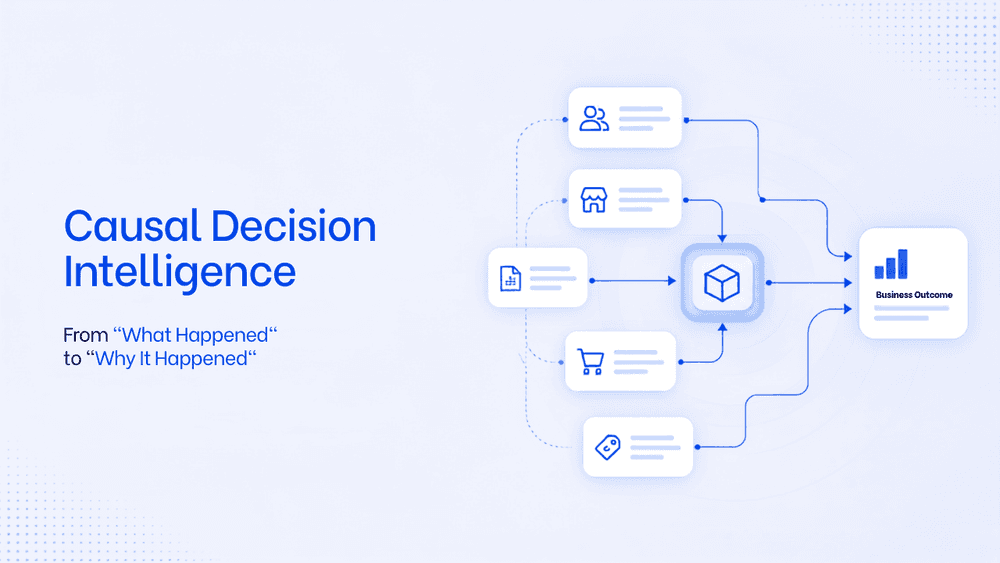
What Is Causal Decision Intelligence? A Framework To Move From "What Happened" to "Why It Happened"
Business intelligence tools are limited in their capability to find the root cause and the trigger behind it. Causal decision intelligence is the AI layer that helps business take faster, smarter decision with an auditable explanation. This will transform the way business analyse data and strategise on teh next actionable steps.

How a Modern Analytics Platform Transforms Business Intelligence
Why faster decision-making, real-time analytics, and AI-driven intelligence separate market leaders from laggards—and how Fire AI closes the gap between data and action.

Closing the Data Decision-Making Gap in Indian Business
Learn how the data decision-making gap stalls growth in Indian enterprises and how causal decision intelligence bridges the analytics gap for teams.