
Quick answer
Predictive analytics uses machine learning and historical data to forecast future business outcomes. It identifies patterns in sales, customer behaviour, and operations to predict what will happen next—enabling proactive decisions on inventory, pricing, and risk. Tools like FireAI make predictive analytics accessible through natural language queries without writing code.
Predictive analytics uses statistical algorithms, machine learning techniques, and historical data to forecast future outcomes and trends. By analyzing patterns in past data, predictive analytics enables organizations to anticipate customer behavior, market changes, and business risks before they occur.
Predictive analytics represents the bridge between descriptive analytics (what happened) and future planning. This capability transforms reactive business practices into proactive strategies, enabling better decision-making and competitive advantage. For example, businesses use predictive analytics to forecast sales trends and optimize inventory management.
What is Predictive Analytics?
Predictive analytics applies statistical algorithms, machine learning techniques, and data mining methods to historical data to forecast future outcomes. The technology analyzes patterns, relationships, and trends in existing data to predict what is likely to happen next, enabling organizations to make informed decisions about future events, customer behavior, and business conditions.
The core principle involves training models on historical data to identify patterns that can be applied to current and future scenarios. These models learn from past outcomes to predict future probabilities, providing organizations with foresight that traditional analytics cannot deliver.
Core Components
Data Preparation: Historical data is collected, cleaned, and transformed into formats suitable for modeling. This includes feature engineering, normalization, and handling missing values to ensure model accuracy. Data quality is essential for reliable predictions, as noted in why data quality matters for analytics.
Algorithm Selection: Appropriate statistical and machine learning algorithms are chosen based on the prediction task, data characteristics, and business requirements. Different algorithms excel at different types of predictions.
Model Training: Algorithms learn patterns from historical data through iterative processes that optimize predictive accuracy. Training involves feeding the model labeled historical data to establish relationships between inputs and outcomes.
Validation and Testing: Models are tested on unseen data to ensure they generalize well to new scenarios. Performance metrics evaluate accuracy, precision, and reliability before deployment.
Deployment and Monitoring: Trained models are integrated into business processes where they provide real-time predictions. Continuous monitoring ensures models maintain accuracy as data patterns evolve. Predictive models are often visualized through business dashboards that track forecast accuracy over time.
How Predictive Analytics Works
Data Collection and Preparation
Predictive analytics begins with comprehensive data gathering:
- Historical transaction data and customer records
- Operational metrics and performance indicators
- External data sources like market conditions
- Demographic and behavioral information
- Time-series data for trend analysis
Data undergoes rigorous preparation to ensure quality and relevance for modeling.
Feature Engineering
Raw data is transformed into predictive features:
- Creating derived variables from existing data
- Time-based features like seasonality and trends
- Categorical variable encoding for numerical processing
- Feature scaling and normalization
- Dimensionality reduction to eliminate noise
Model Development
Various algorithms are applied based on prediction needs:
- Regression models for continuous predictions
- Classification models for categorical outcomes
- Time series models for temporal forecasting (see trend analysis for related techniques)
- Ensemble methods combining multiple models
- Deep learning for complex pattern recognition using large language models and neural networks
Model Training and Validation
Models learn through structured processes:
- Supervised learning with labeled historical data
- Cross-validation to prevent overfitting
- Hyperparameter tuning for optimal performance
- Performance evaluation using accuracy metrics
- Model comparison and selection
Prediction Generation
Trained models produce actionable insights:
- Probability scores for different outcomes
- Confidence intervals indicating prediction reliability
- Feature importance explaining prediction drivers
- Scenario analysis for different conditions
- Real-time predictions for immediate decisions
Types of Predictive Analytics
Regression Analysis
Regression models predict continuous numerical values:
- Linear regression for simple relationships
- Polynomial regression for complex curves
- Multiple regression with multiple predictors
- Time series regression for temporal patterns
Applications include sales forecasting, price prediction, and demand planning.
Classification Models
Classification predicts categorical outcomes:
- Binary classification for yes/no decisions
- Multi-class classification for multiple categories
- Logistic regression for probability estimates
- Decision trees for rule-based predictions
- Neural networks for complex pattern recognition
Used for customer churn prediction, fraud detection, and risk assessment.
Time Series Forecasting
Time series models predict temporal patterns:
- ARIMA models for trend and seasonality
- Exponential smoothing for weighted averages
- Prophet for business forecasting
- LSTM networks for complex temporal patterns
Essential for inventory planning, financial forecasting, and demand prediction.
Clustering and Segmentation
Unsupervised learning identifies natural groupings:
- K-means clustering for customer segmentation
- Hierarchical clustering for taxonomy creation
- Density-based clustering for anomaly detection
- Topic modeling for content categorization
Enables personalized marketing and targeted interventions.
Predictive Analytics vs Other Analytics Types
Descriptive Analytics
Descriptive analytics explains what happened:
- Summarizes historical data and current state
- Provides dashboards and reporting
- Answers "What happened?" questions
- Focuses on past and present performance
- Enables understanding of current conditions
Diagnostic Analytics
Diagnostic analytics explains why things happened:
- Identifies root causes of events
- Performs drill-down analysis
- Answers "Why did this happen?" questions
- Uncovers relationships and dependencies
- Enables problem-solving and improvement
Predictive Analytics
Predictive analytics forecasts what will happen:
- Uses historical data to predict future outcomes
- Applies statistical modeling and machine learning
- Answers "What is likely to happen?" questions
- Enables proactive decision-making
- Supports planning and risk management
Prescriptive Analytics
Prescriptive analytics recommends what to do:
- Suggests optimal actions based on predictions
- Uses optimization and simulation
- Answers "What should we do?" questions
- Enables automated decision-making
- Supports strategy optimization
| Analytics Type | Focus | Questions Answered | Time Orientation | Business Value |
|---|---|---|---|---|
| Descriptive | What happened | What are our sales? | Past/Present | Understanding current state |
| Diagnostic | Why it happened | Why did sales drop? | Past | Problem identification |
| Predictive | What will happen | What will sales be? | Future | Risk management |
| Prescriptive | What to do | How to increase sales? | Future | Decision optimization |
Key Applications
Customer Analytics
Predictive analytics transforms customer relationships:
- Churn prediction identifies at-risk customers
- Lifetime value modeling optimizes marketing spend
- Cross-sell and upsell recommendations increase revenue
- Customer segmentation enables targeted campaigns
- Sentiment analysis predicts satisfaction levels
Financial Services
Financial institutions leverage predictive capabilities:
- Credit scoring assesses loan default risk
- Fraud detection identifies suspicious transactions
- Market prediction informs investment decisions
- Risk modeling evaluates portfolio exposure
- Insurance pricing optimizes premium setting
Retail and E-commerce
Retailers use predictions for operational excellence:
- Demand forecasting optimizes inventory levels
- Price optimization maximizes revenue
- Customer behavior prediction personalizes experiences
- Supply chain optimization reduces costs
- Product recommendation engines drive sales
Manufacturing and Operations
Manufacturing benefits from predictive insights:
- Equipment failure prediction enables preventive maintenance
- Quality control identifies potential defects
- Production optimization improves efficiency
- Supply chain disruption prediction ensures continuity
- Energy consumption forecasting reduces costs
Healthcare
Healthcare organizations improve patient outcomes:
- Disease risk prediction enables early intervention
- Patient readmission prediction improves care coordination
- Treatment effectiveness prediction optimizes protocols
- Resource utilization forecasting improves capacity planning
- Drug interaction prediction enhances safety
Technical Implementation
Data Infrastructure
Predictive analytics requires robust data foundations:
- Data warehouses for structured historical data
- Data lakes for unstructured and streaming data
- Feature stores for reusable predictive features
- Model registries for version control and governance
- Real-time data pipelines for fresh predictions
Machine Learning Platforms
Modern platforms provide comprehensive capabilities:
- AutoML tools for automated model development
- Model deployment and serving infrastructure
- A/B testing frameworks for model validation
- Monitoring and alerting for model performance
- Explainability tools for model interpretation
Model Governance
Enterprise-grade predictive analytics requires governance:
- Model documentation and lineage tracking
- Performance monitoring and drift detection
- Regulatory compliance and audit trails
- Bias detection and fairness assessment
- Model lifecycle management and retirement
Integration Patterns
Predictive models integrate with business systems:
- Real-time APIs for immediate predictions
- Batch processing for scheduled forecasts
- Event-driven triggers for automated actions
- Dashboard integration for user consumption
- Workflow automation for decision execution
Benefits and Challenges
Business Benefits
Proactive Decision-Making: Organizations can anticipate rather than react to events, enabling better planning and risk management.
Competitive Advantage: Predictive insights provide unique market advantages through better customer understanding and operational efficiency.
Cost Reduction: Preventive maintenance and optimized operations reduce costs while improving service quality.
Revenue Optimization: Better pricing, targeting, and product recommendations increase revenue and customer satisfaction.
Risk Management: Early identification of risks enables mitigation strategies and reduces business volatility.
Implementation Challenges
Data Quality Requirements: Predictive models require clean, comprehensive, and relevant historical data to produce accurate predictions.
Skill Gap: Organizations need data scientists and analysts with statistical and machine learning expertise.
Model Maintenance: Models can become less accurate as data patterns change, requiring continuous monitoring and retraining.
Interpretability Issues: Complex models can be difficult to understand and explain, challenging adoption in regulated industries.
Integration Complexity: Embedding predictive capabilities into existing business processes requires careful planning and execution.
Best Practices
Start with Clear Business Objectives
Define specific prediction needs:
- Identify key business questions requiring prediction
- Establish success criteria and evaluation metrics
- Prioritize high-impact use cases for initial implementation
- Ensure executive sponsorship and stakeholder alignment
- Plan for measurable business impact
Ensure Data Quality
Build strong data foundations:
- Implement comprehensive data quality monitoring
- Establish data governance and stewardship
- Create processes for ongoing data validation
- Build feedback loops for continuous improvement
- Maintain detailed data lineage and documentation
Choose Appropriate Models
Select models based on specific needs:
- Match algorithm types to prediction requirements
- Consider computational requirements and scalability
- Evaluate model interpretability for business adoption
- Test multiple approaches for optimal performance
- Plan for model updates and version control
Implement Monitoring and Maintenance
Maintain model effectiveness over time:
- Establish continuous performance monitoring
- Implement drift detection and alerting
- Plan regular model retraining schedules
- Maintain model documentation and governance
- Create processes for model updates and improvements
Focus on Business Adoption
Ensure organizational acceptance:
- Provide clear explanations of model predictions
- Create user-friendly interfaces for prediction consumption
- Train business users on prediction interpretation
- Establish feedback mechanisms for model improvement
- Demonstrate clear business value and ROI
The Future of Predictive Analytics
Automated Machine Learning
AutoML will democratize predictive capabilities:
- Automated feature engineering and selection
- Algorithm selection and hyperparameter tuning
- Model deployment and monitoring automation
- Reduced need for specialized data science skills
- Faster time-to-value for predictive projects
Real-Time Predictions
Streaming analytics will enable immediate predictions:
- Real-time model scoring and decision-making
- Event-driven predictive triggers
- Continuous learning from streaming data
- Edge computing for low-latency predictions
- Integration with IoT and sensor data
Explainable AI
Model interpretability will become standard:
- Techniques for explaining complex model predictions
- Feature importance and contribution analysis
- Model fairness and bias detection
- Regulatory compliance through transparency
- Trust building through explainability
Integrated Analytics
Predictive capabilities will become seamlessly integrated:
- Embedded predictions in business applications
- Predictive insights in operational dashboards
- Automated decision-making workflows
- Predictive alerts and recommendations
- Continuous optimization through AI
Predictive analytics transforms organizations from reactive to proactive entities. By forecasting future outcomes based on historical patterns, businesses can anticipate customer needs, optimize operations, and mitigate risks before they impact performance. As machine learning technologies advance, predictive analytics will become increasingly accessible and integral to business decision-making.
How FireAI Uses Predictive Analytics
FireAI brings predictive analytics to Indian businesses without requiring data science teams or complex ML pipelines:
Natural Language Forecasting: Ask "What will my sales be next quarter?" in plain English or Hindi—FireAI's NLQ engine generates forecasts from your Tally, ERP, or database data instantly.
Zero-Code Predictive Dashboards: Pre-built dashboard templates for common Indian business use cases—sales forecasting, inventory demand, and cash flow prediction—ready in minutes, not months.
Tally Integration for SMBs: A Surat textile manufacturer pulling ₹8 Cr annual revenue can connect Tally data directly and get demand forecasts by product line, helping avoid ₹15–20 lakh in dead inventory each season.
Practical Indian Business Examples:
- A Mumbai FMCG distributor uses predictive analytics to forecast regional demand, reducing stockouts by 30% and saving ₹12 lakh/quarter in lost sales
- A Bengaluru SaaS company predicts customer churn 60 days in advance, enabling targeted retention campaigns that saved ₹45 lakh in ARR
- A Delhi pharmaceutical chain forecasts medicine demand across 50+ stores, cutting expiry waste by ₹8 lakh/month
From Concept to Action: Traditional predictive analytics requires Python, R, and dedicated data scientists. FireAI collapses that into a conversational interface—any business user can ask predictive questions and get answers with confidence intervals, all without writing a single line of code.
Ready to act on your data?
See how teams use FireAI to ask in plain language and get analytics they can trust.
Explore FireAI workflows
Go from this topic into product features and solution paths that match what you read here.
Topic hub
AI Analytics
Guides on natural language querying, AI-powered analytics, forecasting, anomaly detection, and automated insights.
Explore hubFrequently asked questions
Related in this topic
What is Prescriptive Analytics? Examples and Benefits
Prescriptive analytics uses AI and optimization algorithms to recommend specific actions for optimal results. Learn how prescriptive analytics works, which techniques it uses, and how businesses apply it for decision automation and optimization.
What is Descriptive Analytics? Examples and Techniques
Descriptive analytics summarizes historical data to answer "what happened?" Learn how descriptive analytics works, which techniques it uses, and how it provides the foundation for diagnostic, predictive, and prescriptive analytics.
What Is Diagnostic Analytics? Definition, Examples & Techniques
Diagnostic analytics answers WHY something happened — not just what. Learn the definition, 5 key techniques (root cause analysis, drill-down, correlation), and real business examples.
Trend Analysis: Definition, Methods & Examples (With Formulas)
Trend analysis spots patterns in sales, revenue and demand over time. Learn 6 methods (moving averages, regression, time-series), formulas, and real business examples.
From the blog
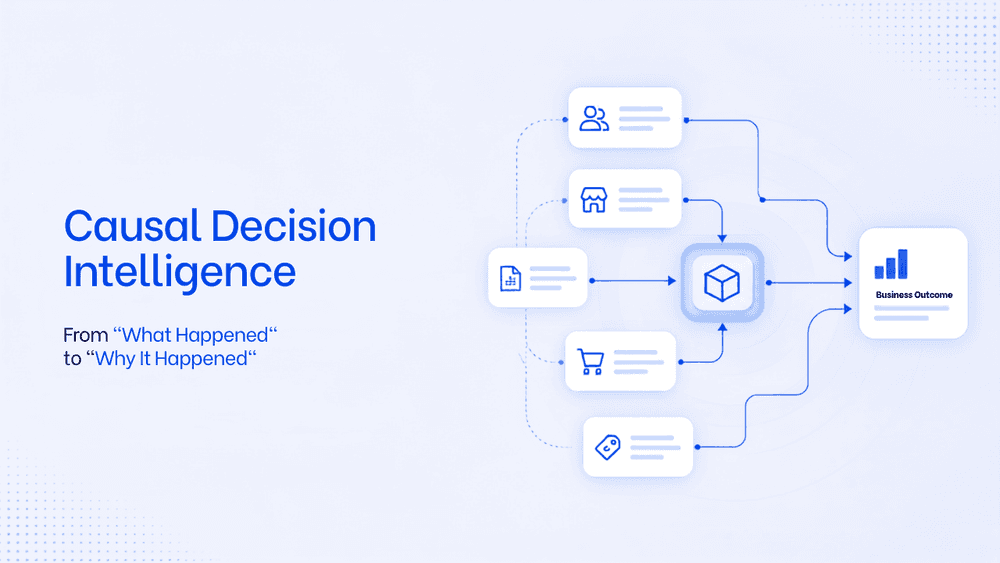
What Is Causal Decision Intelligence? A Framework To Move From "What Happened" to "Why It Happened"
Business intelligence tools are limited in their capability to find the root cause and the trigger behind it. Causal decision intelligence is the AI layer that helps business take faster, smarter decision with an auditable explanation. This will transform the way business analyse data and strategise on teh next actionable steps.
What Is a Data Silo and Why Is It Slowing Down Your Business?
Data silos are silently costing Indian businesses time, money and decisions. Here is what they are, why they form and how to break them for good with FireAI.

How a Modern Analytics Platform Transforms Business Intelligence
Why faster decision-making, real-time analytics, and AI-driven intelligence separate market leaders from laggards—and how Fire AI closes the gap between data and action.