
Quick answer
Trend analysis examines data over time to identify whether metrics are rising, falling, or seasonal. Businesses use it to track sales, revenue, margins, and demand patterns using methods like moving averages, regression, and time-series decomposition. FireAI automates trend analysis through pre-built dashboards and NLQ—ask "Show me revenue trend for the last 12 months" and get instant visualisation.
Trend analysis examines data over time to identify direction, rate of change, and likely next steps. It helps teams answer practical questions like whether revenue is improving, inventory turns are slowing, or demand is becoming more seasonal.
Trend analysis is especially useful when teams want to move from reporting to action. By combining historical data, data visualization, and forecasting methods, organizations can spot changes early and turn those patterns into decisions. It often sits at the core of predictive analytics and business dashboards that monitor performance over time.
Common Business Uses Of Trend Analysis
- Tracking revenue, sales, and margin movement over time
- Monitoring website traffic, leads, and conversion rates
- Forecasting demand, stock requirements, and seasonality
- Identifying whether a KPI change is temporary or part of a larger shift
What is Trend Analysis?
Trend analysis is the process of examining data over time to identify patterns, directions, and changes in performance or behavior. It uses statistical methods and visualization techniques to determine whether key metrics are increasing, decreasing, remaining stable, or following seasonal or cyclical patterns.
The analysis helps organizations understand the trajectory of their business, market conditions, customer behavior, and operational performance. By identifying trends early, companies can anticipate changes, capitalize on opportunities, and mitigate risks before they become significant issues.
Core Characteristics
Temporal Focus: Analysis of data points sequenced over time periods.
Pattern Recognition: Identification of consistent directions and changes in data.
Predictive Value: Insights that support forecasting and planning.
Comparative Analysis: Comparison of trends across different time periods or segments.
Visual Representation: Charts and graphs that make trends immediately apparent.
How Trend Analysis Works
Data Collection and Organization
Trend analysis begins with structured data collection:
- Time Series Data: Sequential data points collected at regular intervals
- Historical Records: Past performance data spanning meaningful time periods
- Comparative Data: Benchmarking against industry standards or competitors
- Segmented Data: Analysis by product, region, customer segment, or other dimensions
- External Factors: Incorporation of market conditions, economic indicators, and environmental variables
Time Series Decomposition
Breaking down time series into component parts:
- Trend Component: Long-term direction of the data (upward, downward, stable)
- Seasonal Component: Regular patterns that repeat over fixed periods
- Cyclical Component: Longer-term fluctuations not tied to calendar seasons
- Random Component: Unexplained variations and noise in the data
- Residual Component: Differences between observed and predicted values
Statistical Methods
Quantitative approaches for trend identification:
- Moving Averages: Smoothing data to reveal underlying trends
- Linear Regression: Fitting straight lines to identify directional trends
- Exponential Smoothing: Weighted averaging that gives more importance to recent data
- Polynomial Regression: Fitting curved lines for non-linear trends
- Seasonal Decomposition: Separating seasonal effects from underlying trends
Pattern Recognition
Advanced techniques for complex trend identification:
- Change Point Detection: Identifying when trends significantly change direction
- Outlier Analysis: Detecting unusual data points that may indicate trend changes
- Correlation Analysis: Examining relationships between multiple trending variables
- Clustering Analysis: Grouping similar trend patterns across different segments
- Machine Learning: Automated pattern recognition in complex datasets
Trend Visualization
Effective presentation of trend insights:
- Line Charts: Standard representation of trends over time
- Area Charts: Emphasizing magnitude of changes over time
- Bar Charts: Comparing trends across different categories or periods
- Sparklines: Miniature charts showing trends in dashboards
- Heat Maps: Visualizing trend patterns across multiple dimensions
Types of Trends
Directional Trends
Overall direction of data movement:
- Upward Trends: Consistent increases in metrics over time
- Downward Trends: Consistent decreases in performance indicators
- Horizontal Trends: Stable performance with no significant directional change
- Non-Linear Trends: Curved patterns that accelerate or decelerate over time
Seasonal Trends
Regular patterns tied to calendar periods:
- Monthly Seasonality: Patterns that repeat every month
- Quarterly Seasonality: Business cycles tied to fiscal quarters
- Annual Seasonality: Holiday or annual event-related patterns
- Weekly Seasonality: Day-of-week or weekend patterns
- Hourly Seasonality: Time-of-day patterns in operational data
Cyclical Trends
Longer-term fluctuations not tied to calendar:
- Business Cycles: Economic expansions and contractions
- Industry Cycles: Sector-specific boom and bust periods
- Product Life Cycles: Introduction, growth, maturity, and decline phases
- Market Cycles: Supply and demand fluctuations
- Technological Cycles: Innovation and adoption patterns
Short-Term vs Long-Term Trends
Different time horizons for analysis:
- Short-Term Trends: Daily or weekly patterns for operational decisions
- Medium-Term Trends: Monthly or quarterly patterns for tactical planning
- Long-Term Trends: Annual or multi-year patterns for strategic planning
- Emerging Trends: New patterns that may indicate future directions
- Historical Trends: Established patterns that provide context
Applications Across Industries
Business Performance Analysis
Understanding organizational trends:
- Revenue Trends: Tracking sales growth or decline patterns
- Profitability Analysis: Examining margin trends by product or service
- Market Share Trends: Monitoring competitive positioning over time
- Customer Acquisition: Analyzing new customer growth patterns
- Employee Productivity: Tracking workforce performance trends
Financial Markets
Analyzing market and investment trends:
- Stock Price Trends: Identifying bullish or bearish market movements
- Commodity Trends: Tracking price movements in raw materials
- Currency Trends: Analyzing exchange rate movements and patterns
- Bond Yield Trends: Monitoring interest rate and credit market patterns
- Portfolio Performance: Analyzing investment return patterns over time
Marketing and Sales
Optimizing customer acquisition and engagement:
- Conversion Rate Trends: Tracking changes in website or campaign performance
- Customer Behavior Trends: Analyzing purchase patterns and preferences
- Channel Performance: Comparing marketing channel effectiveness over time
- Customer Lifetime Value: Tracking changes in customer value over time
- Brand Sentiment: Analyzing social media and review trend patterns
Operations and Supply Chain
Managing operational performance:
- Production Trends: Analyzing manufacturing output and efficiency patterns
- Inventory Trends: Tracking stock levels and turnover patterns
- Supply Chain Performance: Monitoring delivery times and supplier reliability
- Quality Trends: Examining defect rates and quality metrics over time
- Resource Utilization: Tracking equipment and workforce usage patterns
Healthcare and Public Health
Monitoring health trends and outcomes:
- Disease Incidence Trends: Tracking infection rates and public health patterns
- Treatment Effectiveness: Analyzing patient outcome trends over time
- Healthcare Utilization: Monitoring hospital admissions and service usage
- Population Health: Tracking demographic and health indicator trends
- Medical Cost Trends: Analyzing healthcare spending and insurance patterns
Trend Analysis Techniques
Moving Average Analysis
Smoothing techniques for trend identification:
- Simple Moving Average: Equal weighting of data points in the calculation window
- Weighted Moving Average: Recent data points given higher importance
- Exponential Moving Average: Decreasing weights for older data points
- Centered Moving Average: Balanced weighting around the center point
Regression Analysis
Fitting mathematical models to data:
- Linear Regression: Straight-line trends for consistent directional changes
- Polynomial Regression: Curved trends for accelerating or decelerating patterns
- Multiple Regression: Trends influenced by multiple variables
- Logistic Regression: S-shaped trends for adoption or saturation patterns
- Time Series Regression: Incorporating time-based variables in the model
Time Series Forecasting
Predictive trend analysis methods:
- ARIMA Models: Autoregressive integrated moving average for forecasting
- Exponential Smoothing: Trend-based forecasting with smoothing parameters
- Prophet: Facebook's forecasting tool for business time series
- Neural Networks: Deep learning approaches for complex trend patterns
- Ensemble Methods: Combining multiple forecasting models for improved accuracy
Statistical Process Control
Monitoring trends for quality and stability:
Control Charts: Tracking process stability and identifying unusual variations
Run Charts: Visual representation of data over time with median lines
Shewhart Charts: Statistical control charts for process monitoring
Cusum Charts: Cumulative sum charts for detecting small shifts in trends
EWMA Charts: Exponentially weighted moving average control charts
A worked example: spotting a sales trend with a moving average
Trend analysis is easier to follow with real numbers. Here is a three-month moving average applied to monthly sales, the most common trend method for a seasonal Indian business.
A Pune apparel retailer records these monthly sales:
Month Sales (₹ lakh) 3-month moving average Jan 42 — Feb 38 — Mar 47 42.3 Apr 51 45.3 May 49 49.0 Jun 58 52.7 The moving average for March is (42 + 38 + 47) ÷ 3 = 42.3. Each later month drops the oldest figure and adds the newest. The raw sales bounce around month to month. The moving-average column climbs steadily from 42.3 to 52.7. That steady climb is the trend, and it survives the noise that makes any single month misleading.
To put a number on it, take the growth rate between the first and last moving average: (52.7 − 42.3) ÷ 42.3 = 24.6% over four months. The retailer can now plan stock against a real direction instead of reacting to one good or bad month.
Implementation Considerations
Data Quality and Preparation
Ensuring reliable trend analysis:
- Data Completeness: Ensuring sufficient historical data for meaningful analysis
- Data Consistency: Standardizing data collection and measurement methods
- Outlier Handling: Managing unusual data points that could distort trends
- Missing Data: Appropriate handling of gaps in time series data
- Data Granularity: Selecting appropriate time intervals for analysis
Statistical Rigor
Applying proper analytical methods:
- Stationarity Testing: Ensuring data meets statistical assumptions for analysis
- Seasonal Adjustment: Removing seasonal effects to reveal underlying trends
- Autocorrelation Analysis: Understanding dependencies between time series observations
- Model Validation: Testing trend models against holdout data
- Confidence Intervals: Providing uncertainty measures for trend estimates
Visualization Best Practices
Effective trend presentation:
- Clear Time Scales: Appropriate time intervals that reveal meaningful patterns
- Reference Lines: Including benchmarks, targets, and historical comparisons
- Color Coding: Consistent use of colors for different trend types or categories
- Annotation: Highlighting significant events or changes in trend direction
- Responsive Design: Ensuring visualizations work across different devices
Business Context Integration
Connecting trends to business decisions:
- Leading vs Lagging Indicators: Understanding which trends predict future outcomes
- Actionable Insights: Translating trend analysis into specific recommendations
- Stakeholder Communication: Presenting trends in business-relevant terms
- Integration with Planning: Using trends to inform budgeting and strategic planning
- Performance Attribution: Understanding which factors drive observed trends
Benefits and Challenges
Business Benefits
Strategic Planning: Long-term trend insights inform strategic decision-making and resource allocation.
Early Warning Systems: Trend changes provide advance notice of potential issues or opportunities.
Performance Optimization: Understanding trends enables targeted improvements and optimization efforts.
Market Intelligence: Trend analysis reveals market shifts and competitive dynamics.
Risk Management: Early identification of negative trends enables proactive risk mitigation.
Implementation Challenges
Data Quality Issues: Incomplete or inconsistent historical data can lead to unreliable trend analysis.
Seasonal Complexity: Separating seasonal patterns from underlying trends requires sophisticated methods.
Changing Environments: Business conditions can cause trend shifts that invalidate historical analysis.
Over-Reliance on Trends: Past trends don't always predict future performance, especially during disruptions.
Interpretation Complexity: Understanding statistical significance and confidence levels requires expertise.
Best Practices
Establish Clear Objectives
Define trend analysis goals:
- Identify key metrics and time periods for analysis
- Determine the business questions trend analysis should answer
- Establish success criteria for trend identification and interpretation
- Align analysis with organizational planning cycles
- Define stakeholder requirements for trend insights
Choose Appropriate Time Frames
Select relevant analysis periods:
- Match time frames to business planning cycles (weekly, monthly, quarterly, annual)
- Consider data availability and historical context requirements
- Balance short-term tactical needs with long-term strategic insights
- Account for seasonal and cyclical patterns in time frame selection
- Use multiple time horizons for comprehensive trend understanding
Apply Statistical Rigor
Ensure analytical validity:
- Test for statistical significance of identified trends
- Use appropriate confidence intervals for trend estimates
- Validate trend models against holdout data
- Account for autocorrelation and other statistical dependencies
- Apply appropriate seasonal adjustment techniques
Visualize Effectively
Present trends clearly and compellingly:
- Use appropriate chart types for different trend patterns
- Include context and reference points for interpretation
- Highlight significant changes and inflection points
- Provide interactive exploration capabilities
- Ensure accessibility and mobile compatibility
Monitor and Update
Maintain ongoing trend analysis:
- Establish regular analysis cadences and reporting schedules
- Monitor for trend changes and emerging patterns
- Update models and methods as business conditions evolve
- Incorporate new data sources and analytical techniques
- Validate trend predictions against actual outcomes
The Future of Trend Analysis
Advanced Analytics Integration
Trend analysis will incorporate sophisticated techniques:
- Machine Learning Integration: Automated trend detection and classification
- Deep Learning: Complex pattern recognition in high-dimensional data
- Natural Language Processing: Trend analysis of textual data and sentiment
- Computer Vision: Trend analysis of visual data and images
- Real-Time Analytics: Instant trend detection in streaming data
Predictive Trend Analytics
Forward-looking trend capabilities:
- Predictive Trend Modeling: Forecasting future trend directions and magnitudes
- Scenario Analysis: Testing trend implications under different conditions
- Early Warning Systems: Automated detection of emerging trend changes
- Causal Analysis: Understanding what drives observed trends
- Prescriptive Insights: Recommendations based on trend analysis
Integrated Business Intelligence
Trend analysis as part of comprehensive platforms:
- Unified Analytics: Trend analysis integrated with other analytical methods
- Automated Reporting: Self-service trend analysis and reporting
- Collaborative Analysis: Shared trend exploration and annotation
- Mobile Analytics: Trend analysis on mobile devices and in field operations
- API Integration: Trend analysis embedded in business applications
Trend analysis transforms historical data into strategic intelligence, enabling organizations to understand their trajectory and make informed decisions about the future. By identifying patterns and directions in performance data, companies can anticipate changes, capitalize on opportunities, and navigate challenges with greater confidence and success.
How FireAI Uses Trend Analysis
FireAI makes trend analysis conversational and automatic—no spreadsheets, no formulas:
NLQ-Powered Trend Queries: Ask "Show me monthly revenue trend for the last 2 years" or "Is my gross margin improving or declining?" and get instant trend charts with AI-generated commentary explaining the direction, rate of change, and notable inflection points.
Pre-Built Trend Dashboards: Connect your Tally or database and get auto-generated trend dashboards for key business metrics—sales, receivables, inventory turns, and margins—with month-over-month and year-over-year comparisons built in.
Automatic Seasonality Detection: FireAI identifies seasonal patterns in your data automatically. A garment business sees that Q4 sales consistently spike 40% (wedding season), while a cold drink distributor sees summer demand peaks—without configuring any statistical models.
Practical Indian Business Examples:
- A Surat diamond merchant uses trend analysis to track polished stone prices over 24 months, identifying a 3-month lead indicator that helps time ₹50 lakh+ inventory purchases optimally
- A Bengaluru SaaS startup monitors MRR trend weekly, catching a churn acceleration trend 6 weeks early—enabling retention campaigns that saved ₹30 lakh in ARR
- A Nagpur agri-commodities trader tracks seasonal price trends across 15 commodities, timing procurement to save ₹8–12 lakh annually on raw material costs
- A Delhi restaurant chain uses daily sales trend analysis to identify that Tuesday lunch traffic dropped 25% after a competitor opened nearby—prompting a targeted promotion that recovered ₹1.5 lakh/month
From Trend Lines to Business Decisions: The value of trend analysis isn't the chart—it's the decision it enables. FireAI doesn't just show you a trend line; it explains what's happening, flags when something changes, and helps you connect the trend to action.
Ready to act on your data?
See how teams use FireAI to ask in plain language and get analytics they can trust.
Explore FireAI workflows
Go from this topic into product features and solution paths that match what you read here.
Topic hub
Dashboard And Reporting
Practical content on KPI dashboards, executive reporting, trend analysis, charts, and reporting automation.
Explore hubFrequently asked questions
Related in this topic
What is Predictive Analytics? Methods and Examples
Predictive analytics uses statistical algorithms and machine learning to forecast future outcomes based on historical data. Learn how predictive modeling works, which methods are used, and how businesses apply it for sales forecasting, risk management, and strategic planning.
What is Descriptive Analytics? Examples and Techniques
Descriptive analytics summarizes historical data to answer "what happened?" Learn how descriptive analytics works, which techniques it uses, and how it provides the foundation for diagnostic, predictive, and prescriptive analytics.
What is a Business Dashboard? Types and Examples
A business dashboard is a visual interface that displays KPIs, metrics, and data insights in real-time. Learn how business dashboards work, which types exist, and how to design effective dashboards for executives, managers, and teams.
What is a KPI Dashboard? Definition and Examples
A KPI dashboard is a visual display of key performance indicators that gives business leaders an at-a-glance view of performance against goals. Learn what KPI dashboards include, how to build one, and see examples across sales, finance, and operations.
From the blog
What Is a Data Silo and Why Is It Slowing Down Your Business?
Data silos are silently costing Indian businesses time, money and decisions. Here is what they are, why they form and how to break them for good with FireAI.
Data-Driven Customer Success: How Real-Time Metrics Reduce Churn
Discover how data-driven customer success teams use real-time metrics, causal analytics, and tools like FireAI to predict churn before it happens and turn insights into retention.
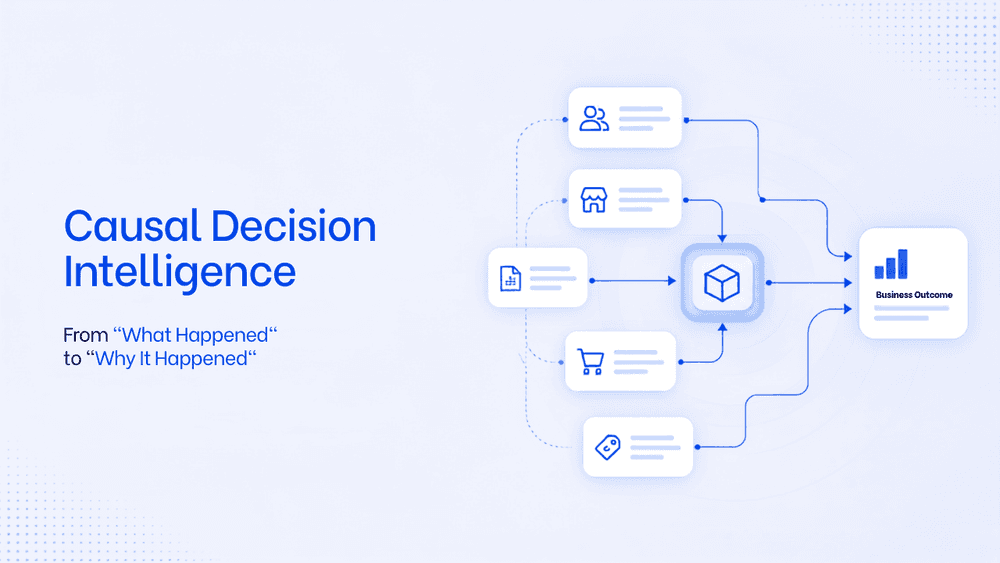
What Is Causal Decision Intelligence? A Framework To Move From "What Happened" to "Why It Happened"
Business intelligence tools are limited in their capability to find the root cause and the trigger behind it. Causal decision intelligence is the AI layer that helps business take faster, smarter decision with an auditable explanation. This will transform the way business analyse data and strategise on teh next actionable steps.