
Quick answer
Data quality is important for analytics because poor data leads to inaccurate insights, flawed decisions, wasted resources, and lost opportunities. High-quality data ensures reliable analytics, better decision-making, regulatory compliance, and significant cost savings through reduced errors and improved efficiency.
Data quality is important for analytics because poor data leads to inaccurate insights, flawed decisions, wasted resources, and lost opportunities. High-quality data ensures reliable analytics, better decision-making, regulatory compliance, and significant cost savings through reduced errors and improved efficiency.
Data quality serves as the foundation for effective analytics, determining whether analytical insights drive successful business outcomes or lead to costly mistakes. In an era where organizations increasingly rely on data-driven decision-making, the quality of underlying data becomes a critical success factor. Understanding why data quality matters for analytics reveals how poor data undermines analytical value and how quality data enables transformative business intelligence. Data quality is essential for predictive analytics, diagnostic analytics, and self-service BI platforms that rely on accurate data for reliable insights.
Why Is Data Quality Important for Analytics?
Data quality is fundamental to analytics because analytical results are only as reliable as the data they're based on. Poor quality data introduces errors, biases, and inconsistencies that compromise analytical insights and lead to flawed business decisions. High-quality data, conversely, enables accurate analysis, reliable insights, and confident decision-making that drives business success.
Foundation of Reliable Insights
Data quality ensures analytical results accurately reflect business reality.
Accuracy Assurance:
High-quality data provides accurate representations of business metrics, customer behavior, and operational performance, enabling reliable analytical insights.
Consistency Maintenance:
Quality data maintains consistent definitions, formats, and measurements across different systems and time periods, ensuring comparable analytical results.
Completeness Verification:
Complete datasets include all necessary information for comprehensive analysis, preventing insights based on incomplete or biased samples.
Timeliness Validation:
Current data reflects the most recent business conditions, ensuring analytical insights remain relevant and actionable.
Prevention of Costly Decision Errors
Poor data quality leads to expensive mistakes that can damage business performance.
Flawed Strategic Decisions:
Inaccurate data can lead to misguided strategic choices, such as investing in unprofitable products or entering unsuccessful markets.
Operational Inefficiencies:
Poor data quality results in inefficient resource allocation, wasted marketing spend, and suboptimal operational decisions.
Financial Losses:
Errors in financial data can lead to incorrect pricing, inventory management mistakes, and compliance violations with significant financial consequences.
Reputational Damage:
Decisions based on flawed data can damage customer relationships and brand reputation when errors become apparent.
Enhanced Analytical Performance
Quality data enables more sophisticated and reliable analytical capabilities.
Advanced Analytics Enablement:
Clean, well-structured data supports machine learning, predictive modeling, and advanced statistical analysis that poor data cannot accommodate.
Algorithm Accuracy:
High-quality data improves the accuracy of analytical algorithms and machine learning models, leading to better predictions and insights.
Insight Reliability:
Quality data ensures analytical insights are trustworthy and can be confidently acted upon by business stakeholders.
Model Performance:
Better data quality leads to more accurate forecasting models, customer segmentation, and trend analysis.
Improved Decision-Making Confidence
Quality data increases confidence in analytical insights and business decisions.
Stakeholder Trust:
High-quality data builds trust in analytical results among executives, managers, and operational teams.
Risk Reduction:
Quality data reduces uncertainty in decision-making, enabling more confident strategic and operational choices.
Validation Capability:
Clean data allows for easy validation of analytical results and assumptions, supporting evidence-based decision-making.
Accountability Enhancement:
Quality data provides clear audit trails for decisions, supporting accountability and performance evaluation.
Cost Reduction and Efficiency Gains
Investing in data quality delivers significant cost savings and efficiency improvements.
Error Correction Savings:
Preventing data quality issues reduces time and costs associated with correcting analytical errors and flawed decisions.
Operational Efficiency:
Quality data streamlines analytical processes, reducing time spent on data cleaning and validation.
Resource Optimization:
Clean data enables better resource allocation and operational planning, reducing waste and inefficiency.
Productivity Improvements:
Analysts spend more time on valuable analysis rather than data quality remediation.
Regulatory Compliance and Risk Management
Quality data ensures compliance with regulatory requirements and reduces business risk.
Compliance Assurance:
Accurate data supports regulatory reporting and audit requirements across industries.
Audit Preparation:
Quality data simplifies audit processes and reduces the risk of compliance violations.
Risk Mitigation:
Clean data enables better risk assessment and management across operational, financial, and strategic domains.
Legal Protection:
Quality data provides defensible evidence for business decisions and regulatory interactions.
Customer Experience Enhancement
Quality data improves customer understanding and service delivery.
Accurate Customer Insights:
Clean data provides reliable insights into customer behavior, preferences, and lifetime value.
Personalization Effectiveness:
Quality data enables more accurate customer segmentation and personalized experiences.
Service Quality Improvement:
Better data supports improved customer service through accurate information and trend analysis.
Relationship Building:
Quality customer data enables more effective relationship management and retention strategies.
Competitive Advantage Creation
Organizations with high-quality data gain significant competitive advantages.
Superior Insights:
Quality data enables deeper, more accurate insights than competitors working with poor data.
Faster Decision-Making:
Clean data accelerates analytical processes and decision cycles.
Innovation Enablement:
Quality data supports more reliable experimentation and innovation initiatives.
Market Responsiveness:
Better data enables faster responses to market changes and customer needs.
Analytics ROI Maximization
Quality data significantly improves the return on analytics investments.
Insight Value Enhancement:
Quality data increases the value and reliability of analytical insights.
User Adoption Increase:
Trustworthy data encourages greater use of analytical tools and insights.
Strategic Value Realization:
Quality data enables realization of the full strategic value of analytics investments.
Long-term Value Creation:
Quality data foundations support sustained analytical value over time.
Implementation Considerations
Organizations need systematic approaches to achieve and maintain data quality.
Quality Framework Development:
Establish comprehensive data quality standards, processes, and governance.
Technology Investment:
Implement data quality tools, validation systems, and monitoring capabilities.
Organizational Alignment:
Build data quality awareness and accountability across the organization.
Continuous Improvement:
Establish ongoing data quality monitoring and improvement processes.
Measuring Data Quality Impact
Organizations should track metrics to evaluate data quality's impact on analytics.
Quality Metrics:
- Data accuracy rates and error frequencies
- Completeness percentages and missing data rates
- Consistency measures across systems
- Timeliness indicators and data freshness
Analytical Impact Metrics:
- Insight accuracy and decision quality improvements
- Error reduction in analytical outputs
- User confidence in analytical results
- Decision-making speed and effectiveness
Business Value Metrics:
- Cost savings from error prevention
- Revenue improvements from better decisions
- Compliance achievement rates
- Customer satisfaction improvements
Common Data Quality Challenges
Organizations face several challenges in maintaining data quality for analytics.
Data Source Complexity:
- Solution: Implement data integration and quality validation at source points
- Approach: Establish quality controls for all data ingestion processes
Volume and Velocity Issues:
- Solution: Automated quality monitoring and real-time validation
- Approach: Implement streaming data quality checks and automated remediation
Human Error Factors:
- Solution: User training and automated data entry validation
- Approach: Implement guided data entry and automated quality checks
System Integration Problems:
- Solution: Master data management and data governance frameworks
- Approach: Establish data standards and integration quality controls
Change Management Issues:
- Solution: Comprehensive training and change management programs
- Approach: Build data quality awareness and accountability across teams
Future of Data Quality in Analytics
Data quality practices will evolve with technological and business changes.
AI-Powered Quality Management:
- Automated data quality assessment using machine learning
- Intelligent data cleansing and error correction
- Predictive quality monitoring and proactive issue prevention
Real-Time Quality Assurance:
- Streaming data quality validation
- Continuous quality monitoring and alerting
- Automated quality improvement workflows
Advanced Quality Analytics:
- Quality trend analysis and predictive quality modeling
- Quality impact assessment on business outcomes
- Quality-driven decision optimization
Integrated Quality Ecosystems:
- Cross-system quality orchestration
- Quality-aware data integration platforms
- Enterprise-wide quality intelligence platforms
Data quality is the cornerstone of effective analytics, determining whether analytical investments deliver value or create risk. Poor data quality undermines analytical reliability, erodes stakeholder confidence, and can lead to costly business mistakes. High-quality data, conversely, enables accurate insights, confident decision-making, and significant competitive advantages.
FireAI emphasizes data quality through intelligent data processing and validation, ensuring that conversational analytics are based on reliable, high-quality data. By maintaining rigorous data quality standards, FireAI enables organizations to derive maximum value from their analytical investments and make decisions with confidence.
As analytics becomes increasingly central to business success, data quality emerges not just as a technical requirement, but as a strategic imperative that determines organizational success in the data-driven economy.
Ready to act on your data?
See how teams use FireAI to ask in plain language and get analytics they can trust.
Explore FireAI workflows
Go from this topic into product features and solution paths that match what you read here.
Topic hub
BI Fundamentals
Foundational guides on business intelligence, analytics architecture, self-service BI, and core data concepts.
Explore hubFrequently asked questions
Related in this topic
Why Is Data-Driven Decision Making Important?
Discover why data-driven decision making is crucial for business success. Learn about improved accuracy, reduced bias, faster insights, and how data-driven approaches lead to better business outcomes and competitive advantages.
Why Is Multilingual Analytics Important?
Discover why multilingual analytics is crucial for global businesses. Learn about accessibility advantages, cultural relevance, market expansion benefits, and how regional language support drives better business intelligence and customer insights.
Why Do Businesses Need Real-Time Analytics?
Discover why real-time analytics is essential for modern businesses. Learn about immediate insights, faster responses, competitive advantages, and how real-time data analysis enables proactive decision-making and operational excellence.
Why Is Natural Language Querying the Future of BI?
Discover why natural language querying represents the future of business intelligence. Learn about conversational analytics, accessibility advantages, and how NLQ transforms data analysis for all users regardless of technical expertise.
From the blog

Democratizing Data: How AI Analytics Levels the Playing Field for Small Businesses and Freelancers
For decades, data-driven decision making was a luxury that only enterprises could afford. Big companies hired data scientists, purchased expensive BI tools, and built complex data warehouses. In exchange, they received precise insights that guided budgets, strategy, and growth.
What Is a Data Silo and Why Is It Slowing Down Your Business?
Data silos are silently costing Indian businesses time, money and decisions. Here is what they are, why they form and how to break them for good with FireAI.
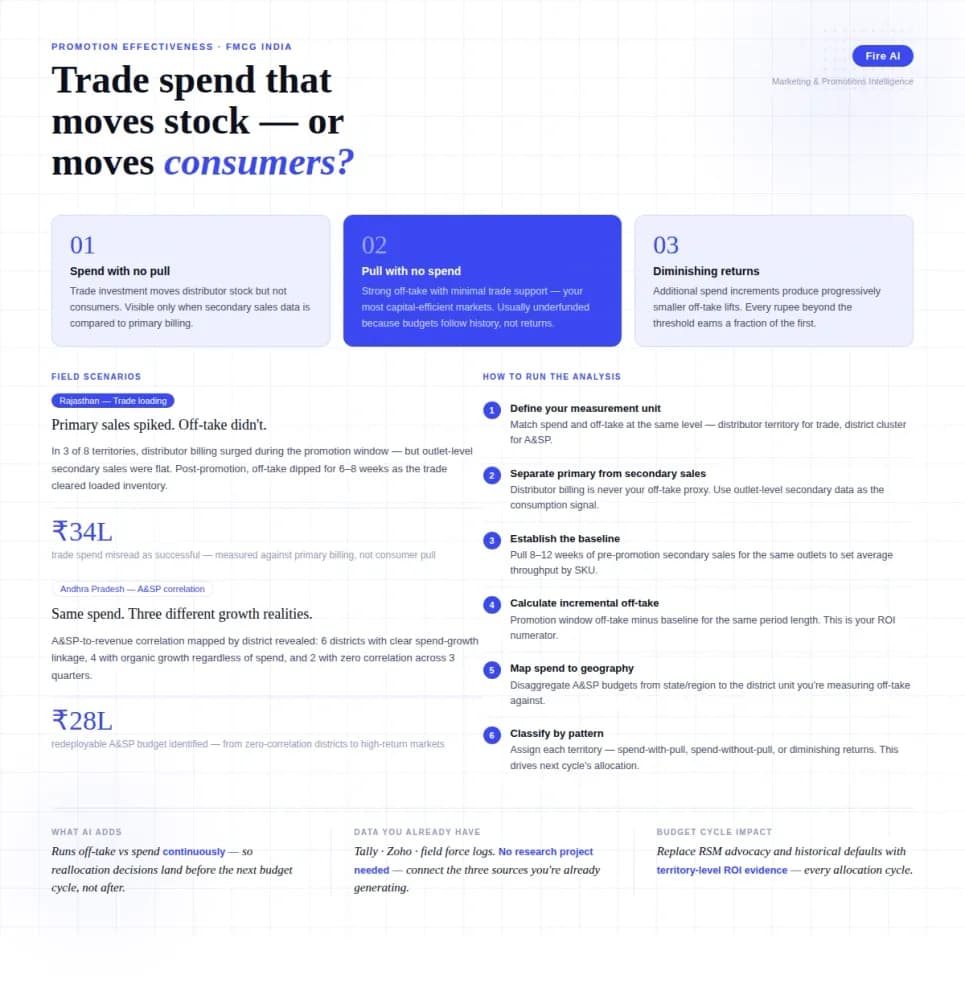
Measuring Promotion Effectiveness: A Data-Driven Guide for FMCG Marketers
FMCG brands in India spend 15–25% of gross revenue on trade promotions and A&SP (advertising and sales promotion) every year. Most can tell you how much they spent. Very few can tell you what it returned. The problem isn't a lack of data — it's that the data lives in disconnected places. Trade spend sits in finance. Off-take data lives with the distributor or field team. A&SP budgets are tracked in a marketing spreadsheet. No single view ties promotional investment to consumer pull at the outlet level. The result is a budget cycle where last year's spend allocation becomes next year's default, because no one has the numbers to argue for something different. This guide walks through how FMCG marketing and trade teams can build a promotion effectiveness framework that actually connects spend to outcome — not just channel-level assumptions.