
Quick answer
Yes, AI can perform sophisticated data analytics—including pattern recognition, predictive modelling, automated reporting, and natural language querying. AI processes large datasets, identifies trends, generates insights, and creates visualisations without manual coding. FireAI lets Indian businesses ask data questions in plain English or Hindi and get AI-generated answers from their Tally, ERP, or database data instantly.
Yes, AI can perform sophisticated data analytics including pattern recognition, predictive modeling, automated reporting, and natural language querying. AI systems can process large datasets, identify trends, generate insights, and create visualizations without manual coding, though they complement rather than replace human analysts for complex strategic decisions.
AI has transformed data analytics from manual processes requiring specialized technical skills to automated, intelligent systems that can process vast amounts of data and generate actionable insights. While AI cannot fully replace human judgment for strategic decision-making, it excels at routine analysis tasks and can handle complexity that would be impractical for humans alone. AI powers augmented analytics and AI-powered business intelligence platforms that enable self-service BI through automated insight generation.
Can AI Do Data Analytics?
Yes, AI can perform comprehensive data analytics including data processing, pattern recognition, predictive modeling, and automated insight generation. Modern AI analytics platforms combine machine learning algorithms with natural language processing to make data analysis accessible to non-technical users while maintaining analytical rigor.
What AI Can Do in Data Analytics
Data Processing and Cleaning
AI systems automatically identify and correct data quality issues, handle missing values, detect outliers, and normalize datasets. This eliminates hours of manual data preparation work.
Pattern Recognition and Trend Analysis
Machine learning algorithms excel at identifying complex patterns in large datasets that might be invisible to human analysts. AI can detect correlations, seasonal trends, and anomalies across millions of data points — the same signals trend analysis is built to surface over time.
Predictive Modeling
AI builds sophisticated predictive models for forecasting sales, customer behavior, inventory needs, and risk assessment. These models continuously learn and improve as new data becomes available.
Natural Language Querying
AI-powered systems allow users to ask questions in plain English rather than writing complex SQL queries. Questions like "What were our best-selling products last quarter?" generate instant results with visualizations.
Automated Reporting and Visualization
AI can create dashboards, charts, and reports automatically, selecting the most appropriate visualization types and highlighting key insights for different audiences.
Real-time Analytics
AI systems can monitor data streams in real-time, triggering alerts when predefined conditions are met and providing instant analysis of live data.
AI Analytics vs Traditional Analytics
| Capability | Traditional Analytics | AI Analytics |
|---|---|---|
| Data Volume | Limited by human processing | Handles billions of records |
| Speed | Hours to days for complex analysis | Real-time to minutes |
| Pattern Discovery | Manual hypothesis testing | Automated pattern detection |
| Predictive Accuracy | Statistical models only | Machine learning optimization |
| User Accessibility | Technical skills required | Natural language interface |
| Scalability | Fixed capacity limits | Elastic scaling |
Technical Implementation of AI Data Analytics
Machine Learning Algorithms
AI analytics platforms use various algorithms including:
- Regression models for forecasting
- Classification algorithms for categorization
- Clustering for customer segmentation
- Neural networks for complex pattern recognition
Data Integration
AI systems connect to multiple data sources simultaneously:
- Relational databases (MySQL, PostgreSQL, SQL Server)
- Cloud data warehouses (BigQuery, Snowflake, Redshift)
- Excel files and CSV datasets
- APIs and streaming data sources
Natural Language Processing
Modern AI analytics uses NLP to:
- Understand business terminology and context
- Generate SQL queries from plain English
- Provide conversational follow up capabilities
- Explain insights in human readable terms
Benefits of AI in Data Analytics
Speed and Efficiency
AI can process data and generate insights in minutes rather than the days or weeks required for manual analysis. This accelerates decision-making across organizations.
Scalability
AI systems handle growing data volumes and complexity without proportional increases in processing time or costs.
Consistency and Accuracy
AI applies the same analytical rigor to every query, eliminating human error and bias from fatigue or oversight.
Democratization of Data
Non-technical users can access sophisticated analytics through natural language interfaces, reducing dependence on specialized analysts.
Continuous Learning
AI models improve over time as they process more data and receive feedback, becoming more accurate and valuable.
Limitations of AI in Data Analytics
Context Understanding
While AI excels at data processing, it may not fully understand nuanced business context or industry-specific factors that human analysts consider.
Data Quality Dependency
AI analytics is only as good as the underlying data. Poor quality or biased data leads to unreliable insights.
Black Box Problem
Some AI models operate as "black boxes" where the reasoning behind conclusions is not transparent, making it difficult to validate results.
Real-World AI Analytics Applications
Retail Analytics
AI analyzes customer purchase patterns, optimizes inventory levels, predicts demand, and personalizes marketing campaigns.
Financial Services
AI detects fraudulent transactions, assesses credit risk, optimizes investment portfolios, and automates regulatory reporting.
Manufacturing
AI predicts equipment failures, optimizes supply chains, analyzes production efficiency, and improves quality control.
Healthcare
AI analyzes patient data for treatment optimization, predicts disease outbreaks, and improves operational efficiency.
Choosing AI Analytics Solutions
When evaluating AI analytics platforms, consider:
- Data Source Compatibility: Support for your existing databases and data formats
- Analytical Capabilities: Range of supported analysis types and algorithms
- User Interface: Ease of use for both technical and non-technical users
- Scalability: Ability to handle growing data volumes and user loads
- Integration Options: APIs, webhooks, and third-party tool connections
- Security and Governance: Data access controls and compliance features
Future of AI Data Analytics
Multimodal Analytics
Future systems will combine structured data analysis with text, images, and voice inputs for richer insights.
Autonomous Analytics
AI systems will proactively identify opportunities and risks without human prompting.
Edge Analytics
AI processing will move closer to data sources for real-time analysis in IoT and mobile environments.
Explainable AI
Advances in explainable AI will make analytical reasoning transparent and auditable.
How FireAI Uses AI for Data Analytics
FireAI is a practical example of AI doing data analytics for Indian businesses—no data scientists, no complex setups:
Natural Language Querying (NLQ): Ask "What were my top 5 customers by revenue last quarter?" or "Show me monthly sales trend" and FireAI's AI generates the SQL query, runs it against your data, and returns the answer with a chart—all in seconds. This is AI doing analytics in real-time.
Zero-Code Analytics: No Python, R, or SQL needed. Connect your Tally, MySQL, PostgreSQL, or Google Sheets data source and start asking questions. The AI handles everything—data retrieval, aggregation, visualisation, and explanation.
AI-Powered Insight Discovery: FireAI doesn't just answer questions—it proactively surfaces insights. "Your top product's margin declined 8% this month" or "3 customers account for 60% of your overdue receivables" appear without being asked.
Tally Integration for Indian SMBs: Most Indian businesses already have years of data in Tally. FireAI connects directly to Tally and applies AI analytics to that data—a ₹10 Cr manufacturer in Ludhiana gets AI-powered insights without migrating data anywhere.
Practical Indian Business Examples:
- A Surat textile trader asks "Which buyers haven't ordered in 30 days?" and gets an AI-generated list with order history and estimated revenue at risk (₹15 lakh across 4 accounts)
- A Bengaluru D2C brand uses AI analytics to identify that 40% of returns come from one product variant, saving ₹7 lakh/month after a quality fix
- A Hyderabad pharma distributor uses NLQ to generate daily sales reports for 50+ stockists that previously took an analyst 3 hours each morning
- A Mumbai restaurant chain asks "Compare food cost percentage across all outlets" and instantly sees which 2 locations are 8% above target—worth ₹4 lakh/month in savings
AI Analytics ≠ Replacing Analysts: AI handles routine questions, data processing, and pattern detection brilliantly. But strategic interpretation, business context, and complex decision-making still benefit from human judgment. FireAI augments your team—it's the analytical capability multiplier that lets a small team operate like a large one.
Ready to act on your data?
See how teams use FireAI to ask in plain language and get analytics they can trust.
Explore FireAI workflows
Go from this topic into product features and solution paths that match what you read here.
Topic hub
AI Analytics
Guides on natural language querying, AI-powered analytics, forecasting, anomaly detection, and automated insights.
Explore hubFrequently asked questions
Related in this topic
What is Predictive Analytics? Methods and Examples
Predictive analytics uses statistical algorithms and machine learning to forecast future outcomes based on historical data. Learn how predictive modeling works, which methods are used, and how businesses apply it for sales forecasting, risk management, and strategic planning.
What is Augmented Analytics? Definition and Benefits
Augmented analytics uses AI and machine learning to automate data preparation, insight discovery, and natural language generation. Learn how augmented analytics works, which benefits it provides, and see real examples of automated insights.
What is AI-Powered Business Intelligence?
AI-powered business intelligence integrates AI and machine learning with traditional BI to automate insights, enable natural language queries, and provide predictive analytics. Learn how AI BI works, which features matter, and how businesses use it.
What is Generative BI? AI-Powered BI Explained
Generative BI uses large language models (LLMs) to automatically generate reports, insights, visualizations, and natural language summaries from business data. Learn what generative BI is, how it works, and how it differs from traditional BI tools.
From the blog
Democratizing Data: How AI Analytics Levels the Playing Field for Small Businesses and Freelancers
For decades, data-driven decision making was a luxury that only enterprises could afford. Big companies hired data scientists, purchased expensive BI tools, and built complex data warehouses. In exchange, they received precise insights that guided budgets, strategy, and growth.
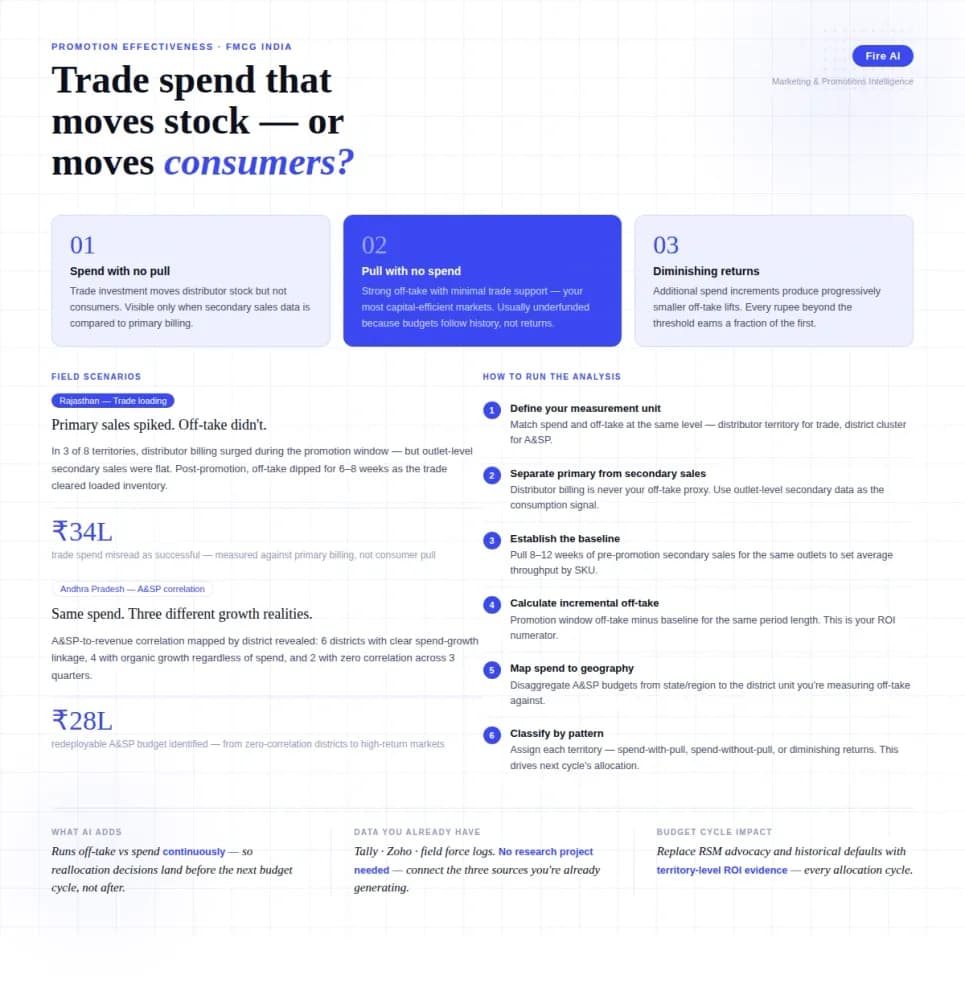
Measuring Promotion Effectiveness: A Data-Driven Guide for FMCG Marketers
FMCG brands in India spend 15–25% of gross revenue on trade promotions and A&SP (advertising and sales promotion) every year. Most can tell you how much they spent. Very few can tell you what it returned. The problem isn't a lack of data — it's that the data lives in disconnected places. Trade spend sits in finance. Off-take data lives with the distributor or field team. A&SP budgets are tracked in a marketing spreadsheet. No single view ties promotional investment to consumer pull at the outlet level. The result is a budget cycle where last year's spend allocation becomes next year's default, because no one has the numbers to argue for something different. This guide walks through how FMCG marketing and trade teams can build a promotion effectiveness framework that actually connects spend to outcome — not just channel-level assumptions.

How a Modern Analytics Platform Transforms Business Intelligence
Why faster decision-making, real-time analytics, and AI-driven intelligence separate market leaders from laggards—and how Fire AI closes the gap between data and action.